Abstract
This study aimed to analyze defensive stability and performance profiles among elite men’s volleyball teams by comparing key performance indicators (KPIs) of the top-ranked teams in the Volleyball Nations League (VNL) 2025. The dataset consisted of 32 team-match observations obtained from Brazil, Italy, France, and Japan during the preliminary competition phase. Across all analyzed matches, the dataset included 124 total sets, 3,349 attack actions, 1,490 blocking actions, 2,887 serve actions, 3,341 setting actions, 2,081 dig actions, and 2,124 reception actions. Match performance data were collected from official Volleyball World statistics and verified using video-based observational analysis through the VBTV platform and Focus X2 performance analysis software. Descriptive statistics (Mean ± S.D.), one-way analysis of variance (ANOVA), effect size analysis (η²), and radar chart performance profiling were used to examine differences among teams. Significant differences were observed in successful blocking (F = 5.531, p = 0.004, η² = 0.372), dig efficiency (F = 3.916, p = 0.019, η² = 0.295), dig success (F = 3.586, p = 0.026, η² = 0.278), net ratio (F = 3.435, p = 0.030, η² = 0.268), and dig error (F = 2.965, p = 0.049, η² = 0.241). All significant variables demonstrated large practical effect sizes. Brazil demonstrated the highest attack efficiency (0.407) and performance index values (111.375), whereas Japan and France demonstrated superior defensive-related indicators, particularly in reception and dig efficiency. The findings indicate that elite men’s volleyball performance in VNL 2025 was differentiated more strongly by defensive stability, blocking effectiveness, and transition control than by offensive variables alone. The results further suggest that successful elite teams maintain distinct tactical and performance profiles characterized by balanced defensive structures and reduced performance instability during competition. These findings provide an evidence-based framework for tactical preparation, performance evaluation, and strategic decision-making in elite volleyball competition. Furthermore, the identified defensive-related indicators may serve as potential performance indicators associated with competitive success for future tactical forecasting and match outcome prediction models in elite volleyball competition.
Keywords
Volleyball Performance Analysis, Defensive Stability, Blocking Effectiveness, Performance Profile, Elite Volleyball,
VNL 2025, Tactical Performance Analysis
1. Introduction
Volleyball performance analysis has become an essential approach for understanding the technical and tactical factors associated with successful competition outcomes in elite-level volleyball. Modern volleyball is characterized by rapid offensive–defensive transitions, tactical variability, and high-performance demands requiring teams to maintain stability across multiple technical components throughout competition. Previous studies have demonstrated that key performance indicators (KPIs), including attack efficiency, serve performance, reception quality, blocking effectiveness, and error management, are strongly associated with match success in elite volleyball environments
. In addition, performance analysis systems have increasingly been applied to evaluate tactical structures, identify competitive patterns, and support evidence-based coaching strategies in modern volleyball
.
Recent developments in sports analytics have increasingly applied performance indicators not only for descriptive and tactical analysis, but also for predictive modeling and competitive forecasting in elite sport environments. Integrated KPIs related to offensive efficiency, defensive stability, transition control, and error management may therefore provide valuable predictive information for evaluating competitive success in elite volleyball tournaments. Previous studies have additionally suggested that strategic performance indicators may contribute to evidence-based match outcome prediction and tactical preparation in high-level competition
.
Recent developments in volleyball analytics have highlighted that successful performance cannot be explained solely by offensive scoring ability. Although attack efficiency remains an important determinant of scoring success, elite teams increasingly rely on defensive organization, blocking systems, transition stability, and reduced performance errors to maintain competitive advantage during high-pressure competition. Marcelino et al.
| [1] | Marcelino R, Mesquita I, Sampaio J. Effects of quality of opposition and match status on technical and tactical performances in elite volleyball. Journal of Sports Sciences. 2011; 29(7): 733–741.
https://doi.org/10.1080/02640414.2011.552516 |
[1]
suggested that elite volleyball outcomes are strongly influenced by the interaction between offensive production and defensive continuity. Similarly, Silva et al.
| [6] | Silva M, Sattler T, Lacerda D, João PV. Match analysis according to the performance of team rotations in volleyball. International Journal of Performance Analysis in Sport. 2016; 16(3): 1076–1086. https://doi.org/10.1080/24748668.2016.11868949 |
[6]
reported that successful teams tend to demonstrate more stable transition structures and continuity performance during prolonged rallies. Previous volleyball studies related to scoring efficacy, tactical sustainability, and performance indicators have additionally emphasized the importance of integrated tactical systems and performance balance in elite competition
| [7] | Rangubhet KR. Performance Analysis System for Volleyball: Efficacy of Scoring Performance. Wichcha Journal Nakhon Si Thammarat Rajabhat University. 2021; 40(2): 71–81.
https://li01.tci-thaijo.org/index.php/wichcha/article/view/252891/173119 |
| [8] | Rangubhet KR, Chailert P, U-siri P. Effect of Volleyball Scoring Performance Analysis on the Women's VNL 2021 Championship Team. In: 2023 Joint International Conference on Digital Arts, Media and Technology with ECTI Northern Section Conference on Electrical, Electronics, Computer and Telecommunications Engineering (ECTI DAMT & NCON). Phuket, Thailand: IEEE; 2023. p. 498–501.
https://doi.org/10.1109/ECTIDAMTNCON57770.2023.10139760 |
| [9] | Rangubhet KR. Jump Float Serves and Tactical Sustainability in Women’s Volleyball: A Statistical Approach with SDG Implications. Journal of Lifestyle and SDGs Review. 2025; 5(5): e06676.
https://doi.org/10.47172/2965-730X.SDGsReview.v5.n05.pe06676 |
| [10] | Sitti K, Rangubhet KR. Tactical and statistical analysis of spiking efficiency by type, zone and set phase in women's volleyball. Frontiers in Sports and Active Living. 2025; 7: 1630870.
https://doi.org/10.3389/fspor.2025.1630870 |
[7-10]
.
Several previous investigations have focused primarily on isolated offensive variables, including attack success and serve efficiency, whereas fewer studies have comprehensively examined integrated performance profiles and defensive-related characteristics among elite teams competing within the same international tournament environment. In elite volleyball, where offensive capabilities among top-ranked teams are often highly similar, smaller differences in blocking effectiveness, defensive stability, transition control, and error management may become decisive factors influencing competitive success. Previous studies on offensive patterns, spiking efficiency, attack performance models, and volleyball tactical analysis have shown that successful teams maintain more efficient performance structures and lower tactical instability during competition
| [11] | Luangtrongkit S, Kongtongkum P, Rangubhet KR. Offensive patterns analysis of Thai Nation team in Volleyball Women’s Nations League 2022. American Journal of Sports Science. 2024; 12(2): 12–19.
https://doi.org/10.11648/j.ajss.20241202.11 |
| [12] | Luangtrongkit S, Rangubhet KR, Kongtongkum P. Analysis of offensive patterns that affect the scoring of Thai National Team in the Volleyball Women’s Nations League 2022. Journal of Thailand National Sports University. 2024; 16(1): 89–98.
https://he02.tci-thaijo.org/index.php/TNSUJournal/article/view/261954 |
| [13] | Santi K, Rangubhet KR. Attack Performance Model Analysis: Outside Spiker of the Champion Women's Team in Volleyball Nations League 2022. In: 2023 Joint International Conference on Digital Arts, Media and Technology with ECTI Northern Section Conference on Electrical, Electronics, Computer and Telecommunications Engineering (ECTI DAMT & NCON). Phuket, Thailand: IEEE; 2023. p. 506–510.
https://doi.org/10.1109/ECTIDAMTNCON57770.2023.10139769 |
| [14] | Sitti K, Rangubhet KR. Volleyball Spiking Analysis for Scoring Success: Performance Indicators in the 2024 VNL Women’s Teams. International Journal of Sports Science and Physical Education. 2025; 10(1): 8–17.
https://doi.org/10.11648/j.ijsspe.20251001.12 |
[11-14]
. In particular, studies involving Volleyball Nations League (VNL) competition demonstrated that scoring success and tactical continuity are strongly associated with offensive organization, transition management, and integrated performance systems among elite volleyball teams
| [9] | Rangubhet KR. Jump Float Serves and Tactical Sustainability in Women’s Volleyball: A Statistical Approach with SDG Implications. Journal of Lifestyle and SDGs Review. 2025; 5(5): e06676.
https://doi.org/10.47172/2965-730X.SDGsReview.v5.n05.pe06676 |
| [11] | Luangtrongkit S, Kongtongkum P, Rangubhet KR. Offensive patterns analysis of Thai Nation team in Volleyball Women’s Nations League 2022. American Journal of Sports Science. 2024; 12(2): 12–19.
https://doi.org/10.11648/j.ajss.20241202.11 |
| [12] | Luangtrongkit S, Rangubhet KR, Kongtongkum P. Analysis of offensive patterns that affect the scoring of Thai National Team in the Volleyball Women’s Nations League 2022. Journal of Thailand National Sports University. 2024; 16(1): 89–98.
https://he02.tci-thaijo.org/index.php/TNSUJournal/article/view/261954 |
| [13] | Santi K, Rangubhet KR. Attack Performance Model Analysis: Outside Spiker of the Champion Women's Team in Volleyball Nations League 2022. In: 2023 Joint International Conference on Digital Arts, Media and Technology with ECTI Northern Section Conference on Electrical, Electronics, Computer and Telecommunications Engineering (ECTI DAMT & NCON). Phuket, Thailand: IEEE; 2023. p. 506–510.
https://doi.org/10.1109/ECTIDAMTNCON57770.2023.10139769 |
[9, 11-13]
.
Furthermore, recent analytical studies in other competitive sports environments have additionally demonstrated the growing importance of integrated performance indicators and tactical evaluation frameworks for understanding successful competition outcomes
| [15] | Santi K, Rangubhet KR. Analytical of Performance Indicators ROV Pro League 2021 Winter Grand Final. In: 2023 Joint International Conference on Digital Arts, Media and Technology with ECTI Northern Section Conference on Electrical, Electronics, Computer and Telecommunications Engineering (ECTI DAMT & NCON). Phuket, Thailand: IEEE; 2023. p. 502–505.
https://doi.org/10.1109/ECTIDAMTNCON57770.2023.10139597 |
| [16] | Santi K, Rangubhet KR. Analysis of Goal Scoring Indicators in The Futsal Thailand League 2021. Journal of Current Science and Technology. 2023; 13(3): 734–743.
https://doi.org/10.59796/jcst.V13N3.2023.1114 |
[15, 16]
. These findings support the broader application of evidence-based performance analysis systems for identifying competitive characteristics and optimizing strategic preparation in elite sport environments.
The Volleyball Nations League (VNL) represents one of the highest standards of international volleyball competition, involving world-class athletes, sophisticated tactical systems, and highly competitive match environments. Therefore, analyzing the performance characteristics of top-ranked teams in VNL 2025 may provide meaningful insights into the key indicators associated with elite-level success. Preliminary findings from the present study indicated that significant differences among the top-ranked teams were primarily observed in defensive-related variables, particularly successful blocking, dig efficiency, dig success, and net performance ratio. These findings suggest that elite volleyball success may be increasingly influenced by defensive stability and tactical continuity rather than isolated offensive production alone.
Therefore, the purpose of this study was to analyze defensive stability and performance profiles among the top-ranked teams in the Volleyball Nations League (VNL) 2025 using descriptive and comparative statistical analysis. Specifically, the study aimed to identify significant differences in offensive and defensive key performance indicators and to examine the integrated tactical structures associated with successful elite men’s volleyball performance.
2. Materials and Methods
2.1. Research Design
This study employed a descriptive and comparative research design to analyze defensive stability and performance profiles among elite men’s volleyball teams competing in the Volleyball Nations League (VNL) 2025. The study focused on identifying offensive and defensive performance characteristics associated with successful elite-level competition through statistical comparison and integrated performance profiling analysis. Descriptive statistics, comparative analysis, effect size analysis, and radar chart visualization techniques were used to evaluate performance differences among top-ranked teams.
2.2. Population and Sample
The population of this study consisted of all teams participating in the 2025 FIVB Men’s Volleyball Nations League (VNL). The sample included the top four ranked teams in the competition, namely Brazil (BRA), Italy (ITA), France (FRA), and Japan (JPN), based on the official final rankings published by the Fédération International de Volleyball (FIVB) and Volleyball World competition database.
A purposive sampling method was employed to select elite teams demonstrating the highest competitive performance level during the tournament. The selection of the top-ranked teams was intended to establish an elite-level performance benchmark and reduce excessive variability associated with lower-ranked teams.
The present study analyzed preliminary round matches involving the four selected teams. Due to incomplete statistical availability during the final competition phase, only matches with complete statistical records were included in the analysis. Each team contributed eight match observations, resulting in a total of 32 team-match observations, including 23 winning performances and 9 losing performances.
Across all analyzed matches, the dataset consisted of 124 total sets, with 81 set wins and 43 set losses recorded among the four teams. A total of 2,907 points scored and 2,692 points conceded were included in the statistical analysis.
The observational dataset additionally consisted of large-scale technical and tactical performance events derived from official match statistics and performance coding procedures. In total, 3,349 attack actions, 1,490 blocking actions, 2,887 serve actions, 3,341 setting actions, 2,081 dig actions, and 2,124 reception actions were analyzed throughout the study. These performance events were extracted from official competition statistics and verified through video-based observational analysis using the Volleyball World VBTV platform and the Focus X2 performance analysis system.
Performance variables analyzed in this study included attack efficiency, block efficiency, serve efficiency, set efficiency, dig efficiency, reception efficiency, error impact, net ratio, performance index, and weighted performance index. All variables were calculated at the match-performance level to evaluate integrated competitive characteristics among elite men’s volleyball teams.
2.3. Scope of the Study
This study focused specifically on the analysis of offensive and defensive key performance indicators (KPIs) in elite men’s volleyball competition. The scope of analysis was limited to preliminary round matches from VNL 2025 involving the top four ranked teams.
The study examined technical and tactical performance variables derived from official match statistics and performance coding procedures. The analyzed variables included attack efficiency, block efficiency, serve efficiency, dig efficiency, reception efficiency, error impact, net ratio, performance index, and weighted performance index.
Performance profiling analysis was additionally conducted to compare the integrated competitive characteristics of each team using radar chart visualization and comparative statistical analysis.
2.4. Data Collection Procedures
Match performance data were collected from official competition sources, including the Volleyball World official website (https://en.volleyballworld.com/volleyball/competitions/volleyball-nations-league/2025) FIVB-related competition records, and official match reports associated with the 2025 FIVB Men’s Volleyball Nations League. Additional match verification and observational review were conducted through live and replay match analysis using the Volleyball World VBTV application.
All performance data were organized and analyzed using the Focus X2 performance analysis software. Match coding and statistical extraction procedures were performed systematically to ensure consistency and analytical accuracy throughout the study.
The observational coding form and performance analysis framework used in this study were developed based on volleyball performance analysis principles and previous performance indicator systems proposed in volleyball-related research
| [5] | Rangubhet KR. Performance Analysis System for Volleyball: Volleyball Performance Indicators. Journal of Thailand National Sports University. 2022; 14(3): 13–24.
https://he02.tci-thaijo.org/index.php/TNSUJournal/article/view/251879 |
| [7] | Rangubhet KR. Performance Analysis System for Volleyball: Efficacy of Scoring Performance. Wichcha Journal Nakhon Si Thammarat Rajabhat University. 2021; 40(2): 71–81.
https://li01.tci-thaijo.org/index.php/wichcha/article/view/252891/173119 |
| [8] | Rangubhet KR, Chailert P, U-siri P. Effect of Volleyball Scoring Performance Analysis on the Women's VNL 2021 Championship Team. In: 2023 Joint International Conference on Digital Arts, Media and Technology with ECTI Northern Section Conference on Electrical, Electronics, Computer and Telecommunications Engineering (ECTI DAMT & NCON). Phuket, Thailand: IEEE; 2023. p. 498–501.
https://doi.org/10.1109/ECTIDAMTNCON57770.2023.10139760 |
| [9] | Rangubhet KR. Jump Float Serves and Tactical Sustainability in Women’s Volleyball: A Statistical Approach with SDG Implications. Journal of Lifestyle and SDGs Review. 2025; 5(5): e06676.
https://doi.org/10.47172/2965-730X.SDGsReview.v5.n05.pe06676 |
| [10] | Sitti K, Rangubhet KR. Tactical and statistical analysis of spiking efficiency by type, zone and set phase in women's volleyball. Frontiers in Sports and Active Living. 2025; 7: 1630870.
https://doi.org/10.3389/fspor.2025.1630870 |
| [13] | Santi K, Rangubhet KR. Attack Performance Model Analysis: Outside Spiker of the Champion Women's Team in Volleyball Nations League 2022. In: 2023 Joint International Conference on Digital Arts, Media and Technology with ECTI Northern Section Conference on Electrical, Electronics, Computer and Telecommunications Engineering (ECTI DAMT & NCON). Phuket, Thailand: IEEE; 2023. p. 506–510.
https://doi.org/10.1109/ECTIDAMTNCON57770.2023.10139769 |
| [14] | Sitti K, Rangubhet KR. Volleyball Spiking Analysis for Scoring Success: Performance Indicators in the 2024 VNL Women’s Teams. International Journal of Sports Science and Physical Education. 2025; 10(1): 8–17.
https://doi.org/10.11648/j.ijsspe.20251001.12 |
[5, 7-10, 13, 14]
.
2.5. Variables of the Study
The independent variable of the study was team classification based on final competition ranking in VNL 2025. The dependent variables consisted of offensive and defensive performance indicators derived from official match statistics and performance analysis procedures.
Attack efficiency represented the relationship between successful attacks, attack errors, and total attack attempts during match play. Block efficiency reflected net defensive effectiveness and blocking outcomes. Serve efficiency evaluated serve performance relative to tactical effectiveness and serving errors. Dig efficiency and reception efficiency represented defensive ball control performance following opponent attacks and serves, respectively.
Error impact represented the influence of performance errors on overall team effectiveness. Integrated performance variables, including net ratio, performance index, and weighted performance index, were additionally calculated to evaluate overall tactical balance and competitive efficiency among teams. All performance indicators were calculated based on match-level statistical outcomes derived from official volleyball performance analysis procedures.
Performance index represented the integrated sum of positive technical actions and tactical efficiency outcomes achieved during competition. Weighted performance index represented an adjusted integrated performance score incorporating weighted values assigned to offensive and defensive indicators according to their tactical contribution during match play.
2.6. Instrument Validity and Reliability
The observational coding form and performance analysis instrument used in this study were evaluated by experts in sports performance analysis and volleyball coaching. Content validity assessment demonstrated an Index of Item-Objective Congruence (IOC) value of 0.89, indicating high agreement regarding the relevance and appropriateness of the selected variables for volleyball performance evaluation.
To ensure reliability of the observational coding process, inter-rater reliability procedures were conducted prior to the main analysis. Match coding and statistical verification were independently reviewed and cross-checked to minimize observational inconsistencies and improve analytical reliability.
2.7. Statistical Analysis
Descriptive statistics, including mean and standard deviation (Mean ± S.D.), were calculated for all performance indicators. One-way analysis of variance (ANOVA) was used to examine differences in performance indicators among the top-ranked teams. Statistical significance was set at p < 0.05.
To evaluate the practical significance of performance differences, effect size analysis was conducted using eta squared (η²). Effect size magnitudes were interpreted according to commonly accepted thresholds as small (0.01), moderate (0.06), and large (0.14).
Performance profile visualization was additionally conducted using radar chart analysis to compare integrated team characteristics across multiple key performance indicators. For visualization purposes, negative-oriented variables were transformed so that higher values consistently represented superior performance profiles.
All statistical analyses were performed using IBM SPSS Statistics version 29.0 (IBM Corp., Armonk, NY, USA).
2.8. Ethical Considerations
This study was approved by the Human Research Ethics Committee of the University of Phayao on Health Sciences and Science and Technology under protocol number HREC-UP-HSST 1.2/174/68.
The study utilized official match statistics and observational performance analysis obtained from publicly accessible competition data and recorded match footage. All procedures were conducted in accordance with institutional ethical standards for sports performance research.
3. Results
3.1. Descriptive Characteristics of the Dataset
The present study analyzed performance data obtained from the top four ranked teams in the Volleyball Nations League (VNL) 2025, including Brazil, Italy, France, and Japan. A total of 32 team-match observations were included in the analysis, consisting of 23 winning performances and 9 losing performances. Across all analyzed matches, 124 total sets were recorded, including 81 set wins and 43 set losses.
The observational dataset additionally consisted of 3,349 attack actions, 1,490 blocking actions, 2,887 serve actions, 3,341 setting actions, 2,081 dig actions, and 2,124 reception actions. Overall, the analyzed teams produced 2,907 total points scored and 2,692 points conceded during competition. Detailed descriptive characteristics of the analyzed dataset are presented in
Table 1.
Table 1. Descriptive Characteristics of Match Performance Data Among Top-Ranked Teams in VNL 2025.
Team | Rank | Match observations | Wins | Losses | Set wins | Set losses | Points for | Points against | Win rate (%) | Set win rate (%) | Point difference |
BRA | 1 | 8 | 7 | 1 | 23 | 8 | 724 | 659 | 87.50 | 74.19 | 65 |
ITA | 2 | 8 | 6 | 2 | 21 | 12 | 771 | 703 | 75.00 | 63.64 | 68 |
FRA | 3 | 8 | 5 | 3 | 19 | 12 | 728 | 689 | 62.50 | 61.29 | 39 |
JPN | 4 | 8 | 5 | 3 | 18 | 11 | 684 | 641 | 62.50 | 62.07 | 43 |
Total | — | 32 | 23 | 9 | 81 | 43 | 2,907 | 2,692 | 71.88 | 65.32 | 215 |
3.2. Comparison of Performance Indicators Among Top-Ranked Teams
Comparative analysis of key performance indicators demonstrated observable differences in offensive and defensive performance structures among the top-ranked teams in VNL 2025. Brazil demonstrated the highest attack efficiency value (0.407 ± 0.080) and the highest performance index value (111.375 ± 27.872), reflecting strong offensive production and overall competitive effectiveness. Italy demonstrated relatively balanced values across offensive and defensive variables, particularly in set efficiency (0.301 ± 0.124) and weighted performance index (393.875 ± 86.817).
France demonstrated the highest dig efficiency value (0.275 ± 0.223) and superior reception efficiency (0.240 ± 0.063), indicating strong defensive transition characteristics and rally continuation performance. Japan demonstrated the highest reception efficiency value (0.256 ± 0.102) and stable defensive-related indicators, reflecting strong ball control and defensive organization throughout competition.
Although offensive indicators such as attack efficiency and set efficiency demonstrated relatively similar values among teams, greater variability was observed in defensive-related variables, including dig efficiency, successful blocking, and net ratio. Detailed descriptive statistics for all performance indicators are presented in
Table 2.
Table 2. Comparison of Key Performance Indicators Among Top-Ranked Teams in VNL 2025.
Performance indicators | BRA Mean ± S.D. | ITA Mean ± S.D. | FRA Mean ± S.D. | JPN Mean ± S.D. | Overall Mean ± S.D. |
Attack Efficiency | 0.407 ± 0.080 | 0.376 ± 0.059 | 0.361 ± 0.089 | 0.362 ± 0.062 | 0.376 ± 0.072 |
Block Efficiency | -0.243 ± 0.143 | -0.200 ± 0.113 | -0.207 ± 0.087 | -0.292 ± 0.111 | -0.236 ± 0.116 |
Serve Efficiency | -0.089 ± 0.032 | -0.101 ± 0.062 | -0.152 ± 0.089 | -0.102 ± 0.049 | -0.111 ± 0.063 |
Set Efficiency | 0.371 ± 0.087 | 0.301 ± 0.124 | 0.298 ± 0.101 | 0.301 ± 0.085 | 0.318 ± 0.100 |
Dig Efficiency | 0.018 ± 0.179 | 0.251 ± 0.184 | 0.275 ± 0.223 | 0.264 ± 0.089 | 0.202 ± 0.199 |
Reception Efficiency | 0.183 ± 0.110 | 0.169 ± 0.089 | 0.240 ± 0.063 | 0.256 ± 0.102 | 0.212 ± 0.096 |
Error Impact | 0.767 ± 0.162 | 0.680 ± 0.128 | 0.745 ± 0.124 | 0.707 ± 0.205 | 0.725 ± 0.154 |
Net Ratio | 0.652 ± 0.110 | 0.571 ± 0.054 | 0.587 ± 0.058 | 0.543 ± 0.051 | 0.588 ± 0.080 |
Performance Index | 111.375 ± 27.872 | 104.750 ± 21.097 | 103.000 ± 17.881 | 90.875 ± 27.121 | 102.500 ± 23.891 |
Weighted Performance Index | 403.125 ± 101.240 | 393.875 ± 86.817 | 379.000 ± 71.170 | 333.500 ± 87.512 | 377.375 ± 87.340 |
3.3. Differences in Performance Indicators Among Top-Ranked Teams
One-way analysis of variance (ANOVA) revealed significant differences in several performance indicators among the top-ranked teams in VNL 2025. Significant differences were observed in dig error (F = 2.965, p = 0.049), successful blocking (F = 5.531, p = 0.004), dig success (F = 3.586, p = 0.026), dig efficiency (F = 3.916, p = 0.019), and net ratio (F = 3.435, p = 0.030).
Among the analyzed variables, successful blocking demonstrated the highest statistical difference among teams, indicating that blocking effectiveness may represent one of the most important distinguishing characteristics among elite men’s volleyball teams. Dig-related variables additionally demonstrated significant differences, suggesting that defensive stability and transition control contributed substantially to overall team performance during competition.
In contrast, offensive-related variables such as attack efficiency, serve efficiency, and set efficiency did not demonstrate statistically significant differences among the analyzed teams. These findings indicate that elite teams may demonstrate relatively similar offensive capabilities, whereas defensive-related indicators may better differentiate competitive performance among top-ranked teams. Detailed ANOVA results are presented in
Table 3.
Table 3. One-Way ANOVA and Effect Size Analysis of Significant Performance Indicators Among Top-Ranked Teams in VNL 2025.
Performance Indicators | F | p-value | η² (Eta Squared) | Magnitude |
Dig Error | 2.965 | 0.049* | 0.241 | Large |
Successful Blocking | 5.531 | 0.004** | 0.372 | Large |
Dig Success | 3.586 | 0.026* | 0.278 | Large |
Dig Efficiency | 3.916 | 0.019* | 0.295 | Large |
Net Ratio | 3.435 | 0.030* | 0.268 | Large |
** p < 0.01
Effect size analysis demonstrated that all statistically significant variables exhibited large practical effects. Successful blocking demonstrated the largest effect size (η² = 0.372), followed by dig efficiency (η² = 0.295), dig success (η² = 0.278), net ratio (η² = 0.268), and dig error (η² = 0.241).
These findings indicate that defensive-related variables and blocking effectiveness produced substantial practical differences among the top-ranked teams in VNL 2025. The large effect sizes observed in defensive performance indicators further suggest that tactical stability and defensive consistency may represent critical determinants of elite-level success.
Post hoc comparisons indicated that Brazil demonstrated significantly higher successful blocking values compared with Japan, whereas France and Japan demonstrated significantly higher dig efficiency values compared with Brazil.
3.4. Performance Profile Analysis
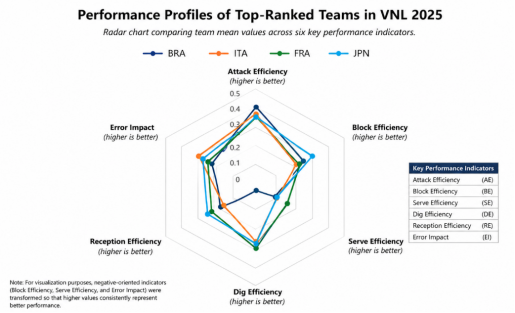
Radar chart visualization demonstrated distinct performance profiles among the top-ranked teams in VNL 2025. Brazil demonstrated superior offensive-related indicators, particularly attack efficiency, set efficiency, and overall performance index values. France exhibited strong defensive transition characteristics, reflected by the highest dig efficiency values among the analyzed teams. Japan demonstrated superior reception efficiency and stable defensive-related indicators, while Italy demonstrated a relatively balanced integrated performance profile across multiple variables.
Figure 1. Radar Chart Visualization of Performance Profiles Among Top-Ranked Teams in VNL 2025.
The radar chart additionally illustrated that elite volleyball success may be achieved through different tactical identities and integrated performance structures rather than through reliance on a single dominant technical skill alone. Despite relatively similar offensive production among teams, the greatest performance variability was observed in defensive stability, blocking effectiveness, and transition-related indicators. These findings suggest that defensive organization and tactical continuity may represent critical distinguishing characteristics among elite men’s volleyball teams in VNL 2025.
3.5. Tactical and Performance Implications of Defensive-Related Indicators
The present findings demonstrated that several defensive-related indicators, particularly successful blocking, dig efficiency, and net ratio, consistently differentiated top-ranked teams in VNL 2025. These variables may therefore represent important performance indicators associated with competitive success in elite men’s volleyball. In particular, successful blocking demonstrated the highest effect size among all analyzed variables, suggesting strong practical importance for tactical preparation and performance evaluation in elite volleyball competition. These findings may additionally contribute to future data-driven performance analysis approaches in volleyball environments.
Table 4. Tactical and Performance Implications of Defensive-Related Indicators in Elite Men’s Volleyball Competition.
Indicator | Tactical Meaning | Competitive Performance Implication |
Successful Blocking | Net defensive stability | Associated with competitive control |
Dig Efficiency | Transition continuity | Associated with rally sustainability |
Net Ratio | Overall tactical balance | Associated with tactical advantage |
Error Impact | Performance instability | Associated with performance instability |
4. Discussion
The purpose of this study was to analyze defensive stability and performance profiles among the top-ranked teams in the Volleyball Nations League (VNL) 2025 through descriptive and comparative statistical analysis. The main findings demonstrated that elite men’s volleyball performance was differentiated not only by offensive production, but more importantly by defensive stability, blocking effectiveness, and transition-related performance characteristics. Significant differences among the top-ranked teams were primarily observed in defensive-related variables, including successful blocking, dig efficiency, dig success, and net ratio. These findings suggest that defensive organization and tactical continuity may represent some of the most important distinguishing characteristics in elite men’s volleyball competition.
4.1. Blocking Performance
One of the most important findings of the present study was the significant difference in successful blocking performance among teams, which also demonstrated the largest effect size (F = 5.531, p = 0.004, η² = 0.372). This result indicates that net defense and blocking effectiveness played a decisive role in differentiating elite-level performance among the top-ranked teams. Previous volleyball studies have consistently reported that blocking performance contributes substantially to successful match outcomes by limiting opponent attack opportunities and increasing transition scoring potential
. In elite competition, where offensive efficiency among teams is often highly comparable, effective blocking systems may become a critical tactical advantage capable of disrupting offensive rhythm and reducing scoring continuity. Marcelino et al.
| [1] | Marcelino R, Mesquita I, Sampaio J. Effects of quality of opposition and match status on technical and tactical performances in elite volleyball. Journal of Sports Sciences. 2011; 29(7): 733–741.
https://doi.org/10.1080/02640414.2011.552516 |
[1]
additionally suggested that elite teams tend to demonstrate more efficient counterattack and transition structures supported by stable defensive systems. The findings of the present study are also consistent with previous volleyball scoring and tactical investigations emphasizing the importance of net control, scoring efficiency, and defensive organization during elite VNL competition
. Furthermore, recent attack performance model analysis in VNL competition demonstrated that successful outside hitters and championship teams frequently exhibit strong offensive–defensive balance supported by stable blocking systems and transition continuity
| [13] | Santi K, Rangubhet KR. Attack Performance Model Analysis: Outside Spiker of the Champion Women's Team in Volleyball Nations League 2022. In: 2023 Joint International Conference on Digital Arts, Media and Technology with ECTI Northern Section Conference on Electrical, Electronics, Computer and Telecommunications Engineering (ECTI DAMT & NCON). Phuket, Thailand: IEEE; 2023. p. 506–510.
https://doi.org/10.1109/ECTIDAMTNCON57770.2023.10139769 |
[13]
.
4.2. Defensive Stability
The present findings additionally revealed significant differences in dig efficiency and dig success among the analyzed teams. Dig efficiency demonstrated a significant difference among teams (F = 3.916, p = 0.019, η² = 0.295), while dig success also differed significantly (F = 3.586, p = 0.026, η² = 0.278). These findings indicate that defensive ball control following opponent attacks was an important component of elite team performance. Modern volleyball increasingly emphasizes transition play and rally continuation, requiring teams to maintain stable defensive systems capable of converting difficult defensive situations into organized offensive opportunities. Silva et al.
| [6] | Silva M, Sattler T, Lacerda D, João PV. Match analysis according to the performance of team rotations in volleyball. International Journal of Performance Analysis in Sport. 2016; 16(3): 1076–1086. https://doi.org/10.1080/24748668.2016.11868949 |
[6]
reported that successful teams frequently exhibit superior continuity performance and defensive transition efficiency during prolonged rallies. Similarly, Hughes and Bartlett
emphasized that modern performance analysis should focus not only on isolated technical skills but also on integrated tactical interactions occurring during competition. Previous volleyball investigations have additionally demonstrated that elite teams with higher defensive efficiency tend to maintain greater tactical sustainability and reduced performance instability during high-pressure situations
| [1] | Marcelino R, Mesquita I, Sampaio J. Effects of quality of opposition and match status on technical and tactical performances in elite volleyball. Journal of Sports Sciences. 2011; 29(7): 733–741.
https://doi.org/10.1080/02640414.2011.552516 |
| [18] | Palao JM, Manzanares P, Ortega E. Techniques used and efficacy of volleyball skills in relation to gender. International Journal of Performance Analysis in Sport. 2009; 9(2): 281–293.
https://doi.org/10.1080/24748668.2009.11868484 |
[1, 18]
. Comparable findings were reported in studies related to tactical sustainability, spiking efficiency, and scoring efficacy in volleyball, which indicated that successful teams tend to minimize defensive instability and maintain efficient transition structures throughout competition
. Moreover, offensive pattern investigations in VNL competition demonstrated that rally continuity and structured transition organization strongly influence scoring opportunities and competitive stability among elite teams
.
4.3. Offensive-Related Indicators
Another important finding was that offensive variables, including attack efficiency and serve efficiency, demonstrated relatively smaller differences among the analyzed teams than initially expected. Brazil demonstrated the highest attack efficiency value (0.407 ± 0.080), whereas the remaining teams demonstrated relatively comparable offensive values. However, offensive variables alone did not fully explain the competitive differences observed among elite teams. This finding may indicate that elite international volleyball teams currently demonstrate increasingly standardized offensive systems due to advances in tactical preparation, physical conditioning, opponent scouting systems, and analytical support technologies. Drikos et al.
suggested that elite offensive systems tend to demonstrate lower variability among top-ranked teams, particularly during international competition. Consequently, smaller differences in defensive organization, error management, and transition effectiveness may become increasingly important determinants of success in high-level volleyball competition. This interpretation aligns with previous investigations suggesting that elite volleyball outcomes are frequently influenced by the balance between scoring efficiency and error reduction rather than offensive production alone
. Similar observations were also reported in recent VNL spiking analysis studies, which demonstrated that offensive success in elite volleyball is highly dependent on tactical context, attack organization, and continuity structures rather than isolated attacking actions alone
| [10] | Sitti K, Rangubhet KR. Tactical and statistical analysis of spiking efficiency by type, zone and set phase in women's volleyball. Frontiers in Sports and Active Living. 2025; 7: 1630870.
https://doi.org/10.3389/fspor.2025.1630870 |
| [14] | Sitti K, Rangubhet KR. Volleyball Spiking Analysis for Scoring Success: Performance Indicators in the 2024 VNL Women’s Teams. International Journal of Sports Science and Physical Education. 2025; 10(1): 8–17.
https://doi.org/10.11648/j.ijsspe.20251001.12 |
[10, 14]
. In addition, attack model analysis of VNL outside spikers revealed that scoring effectiveness is strongly associated with offensive decision-making efficiency and tactical system integration during competition
| [13] | Santi K, Rangubhet KR. Attack Performance Model Analysis: Outside Spiker of the Champion Women's Team in Volleyball Nations League 2022. In: 2023 Joint International Conference on Digital Arts, Media and Technology with ECTI Northern Section Conference on Electrical, Electronics, Computer and Telecommunications Engineering (ECTI DAMT & NCON). Phuket, Thailand: IEEE; 2023. p. 506–510.
https://doi.org/10.1109/ECTIDAMTNCON57770.2023.10139769 |
[13]
.
4.4. Performance Profiling
Radar chart visualization further demonstrated that each top-ranked team exhibited distinct tactical and performance characteristics. Brazil demonstrated superior offensive efficiency and overall performance index values, whereas Japan demonstrated stronger reception efficiency and defensive-related indicators. France exhibited the highest dig efficiency value, reflecting strong defensive transition capability, while Italy demonstrated a relatively balanced overall performance structure across multiple KPIs. These findings support the concept that successful volleyball performance may be achieved through different tactical identities and integrated performance structures rather than through a single dominant playing style alone. Similar observations have been reported in previous offensive pattern and tactical analysis studies in elite volleyball competition
| [6] | Silva M, Sattler T, Lacerda D, João PV. Match analysis according to the performance of team rotations in volleyball. International Journal of Performance Analysis in Sport. 2016; 16(3): 1076–1086. https://doi.org/10.1080/24748668.2016.11868949 |
| [10] | Sitti K, Rangubhet KR. Tactical and statistical analysis of spiking efficiency by type, zone and set phase in women's volleyball. Frontiers in Sports and Active Living. 2025; 7: 1630870.
https://doi.org/10.3389/fspor.2025.1630870 |
| [11] | Luangtrongkit S, Kongtongkum P, Rangubhet KR. Offensive patterns analysis of Thai Nation team in Volleyball Women’s Nations League 2022. American Journal of Sports Science. 2024; 12(2): 12–19.
https://doi.org/10.11648/j.ajss.20241202.11 |
| [12] | Luangtrongkit S, Rangubhet KR, Kongtongkum P. Analysis of offensive patterns that affect the scoring of Thai National Team in the Volleyball Women’s Nations League 2022. Journal of Thailand National Sports University. 2024; 16(1): 89–98.
https://he02.tci-thaijo.org/index.php/TNSUJournal/article/view/261954 |
[6, 10-12]
. Recent analytical frameworks in volleyball performance research have additionally emphasized that elite team success is increasingly associated with balanced tactical systems integrating offensive production, defensive continuity, and error reduction strategies
| [5] | Rangubhet KR. Performance Analysis System for Volleyball: Volleyball Performance Indicators. Journal of Thailand National Sports University. 2022; 14(3): 13–24.
https://he02.tci-thaijo.org/index.php/TNSUJournal/article/view/251879 |
| [8] | Rangubhet KR, Chailert P, U-siri P. Effect of Volleyball Scoring Performance Analysis on the Women's VNL 2021 Championship Team. In: 2023 Joint International Conference on Digital Arts, Media and Technology with ECTI Northern Section Conference on Electrical, Electronics, Computer and Telecommunications Engineering (ECTI DAMT & NCON). Phuket, Thailand: IEEE; 2023. p. 498–501.
https://doi.org/10.1109/ECTIDAMTNCON57770.2023.10139760 |
| [9] | Rangubhet KR. Jump Float Serves and Tactical Sustainability in Women’s Volleyball: A Statistical Approach with SDG Implications. Journal of Lifestyle and SDGs Review. 2025; 5(5): e06676.
https://doi.org/10.47172/2965-730X.SDGsReview.v5.n05.pe06676 |
[5, 8, 9]
.
4.5. Predictive Implications
The present findings additionally suggest that defensive-related indicators may serve as valuable performance indicators associated with competitive success for future volleyball performance modeling and tactical forecasting systems. In particular, successful blocking, dig efficiency, and net ratio consistently differentiated elite teams and demonstrated large practical effect sizes, indicating strong potential for inclusion in evidence-based match outcome prediction frameworks. These findings support the growing application of strategic performance indicators for predictive analytics in elite volleyball competition.
4.6. Practical Implications
The findings of the present study may provide valuable implications for coaches, performance analysts, and sport scientists involved in elite volleyball preparation. The results suggest that training programs should emphasize not only attack performance, but also blocking systems, defensive stability, transition control, and error reduction strategies
| [19] | Valunpion A, Rangubhet KR. Vertical jump performance gains from plyometric and air alert training in volleyball. Frontiers in Sports and Active Living. 2025; 7: 1735291.
https://doi.org/10.3389/fspor.2025.1735291 |
[19]
. In particular, the large effect sizes observed in defensive-related variables indicate that improvements in blocking effectiveness and defensive consistency may substantially influence overall competitive performance in elite volleyball environments. These findings further support the application of integrated performance profiling and evidence-based tactical evaluation systems in modern volleyball analysis
| [4] | Hughes M, Bartlett R. The use of performance indicators in performance analysis. Journal of Sports Sciences. 2002; 20(10): 739–754. https://doi.org/10.1080/026404102320675602 |
| [5] | Rangubhet KR. Performance Analysis System for Volleyball: Volleyball Performance Indicators. Journal of Thailand National Sports University. 2022; 14(3): 13–24.
https://he02.tci-thaijo.org/index.php/TNSUJournal/article/view/251879 |
| [8] | Rangubhet KR, Chailert P, U-siri P. Effect of Volleyball Scoring Performance Analysis on the Women's VNL 2021 Championship Team. In: 2023 Joint International Conference on Digital Arts, Media and Technology with ECTI Northern Section Conference on Electrical, Electronics, Computer and Telecommunications Engineering (ECTI DAMT & NCON). Phuket, Thailand: IEEE; 2023. p. 498–501.
https://doi.org/10.1109/ECTIDAMTNCON57770.2023.10139760 |
[4, 5, 8]
. Furthermore, recent analytical frameworks developed in volleyball and other competitive sport environments have demonstrated the growing importance of performance indicator systems and tactical modeling approaches for supporting strategic preparation and competition analysis
| [15] | Santi K, Rangubhet KR. Analytical of Performance Indicators ROV Pro League 2021 Winter Grand Final. In: 2023 Joint International Conference on Digital Arts, Media and Technology with ECTI Northern Section Conference on Electrical, Electronics, Computer and Telecommunications Engineering (ECTI DAMT & NCON). Phuket, Thailand: IEEE; 2023. p. 502–505.
https://doi.org/10.1109/ECTIDAMTNCON57770.2023.10139597 |
| [16] | Santi K, Rangubhet KR. Analysis of Goal Scoring Indicators in The Futsal Thailand League 2021. Journal of Current Science and Technology. 2023; 13(3): 734–743.
https://doi.org/10.59796/jcst.V13N3.2023.1114 |
| [20] | Valunpion A, Rangubhet KR. Performance and equity in the 100-meter sprint: Contributions to healthy and inclusive athletic development. Journal of Lifestyle and SDGs Review. 2025; 5(1): e04881.
https://doi.org/10.47172/2965-730X.SDGsReview.v5.n01.pe04881 |
[15, 16, 20]
.
4.7. Limitations
First, the analysis was limited to preliminary round matches because complete statistical data from the final competition phase were not consistently available for all teams. Second, the study focused exclusively on the top-ranked teams, which may limit the generalizability of findings to lower-ranked or developing teams. Finally, the study primarily utilized match-level statistical indicators and did not include contextual variables such as rotation systems, situational pressure, setter distribution patterns, or player-specific tactical roles. Future research should incorporate more advanced contextual, tactical, and predictive analyses to further explain competitive success in elite volleyball performance.
5. Conclusion
The present study demonstrated that elite men’s volleyball performance in the Volleyball Nations League (VNL) 2025 was differentiated not merely by offensive scoring ability, but more importantly by defensive stability, blocking effectiveness, and tactical continuity. Although offensive indicators such as attack efficiency remained important components of competitive success, the most decisive differences among the top-ranked teams were observed in successful blocking, dig efficiency, dig success, and net performance ratio. These findings indicate that elite-level success is increasingly determined by the ability to maintain defensive organization, reduce performance instability, and sustain tactical effectiveness during high-pressure competition.
The results further revealed that top-ranked teams exhibited distinct performance profiles and tactical identities. Brazil demonstrated superior offensive efficiency and overall performance production, whereas Japan and France demonstrated stronger defensive-related characteristics, particularly in reception stability and transition performance. Italy exhibited a more balanced integrated performance structure across multiple key performance indicators. These findings suggest that successful elite volleyball performance cannot be explained by a single dominant technical variable alone, but rather by the interaction between offensive efficiency, defensive organization, transition control, and error management.
Importantly, the large effect sizes observed in defensive-related indicators suggest that modern elite volleyball competition may increasingly depend on blocking systems, defensive continuity, and rally sustainability rather than isolated scoring actions alone. The present findings therefore support the growing importance of integrated performance profiling and evidence-based tactical analysis in elite volleyball environments.
Overall, this study contributes to the advancement of volleyball performance analysis by demonstrating that defensive stability and tactical balance represent critical distinguishing characteristics among elite men’s volleyball teams. The findings provide a practical and evidence-based framework for coaches, analysts, and sport scientists seeking to optimize tactical preparation, defensive systems, and competitive performance in international volleyball competition.
Furthermore, the findings of this study may contribute to the future development of evidence-based performance evaluation and tactical analysis systems in elite volleyball competition.
Abbreviations
VNL | Volleyball Nations League |
KPI | Key Performance Indicator |
ANOVA | Analysis of Variance |
IOC | Index of Item-Objective Congruence |
BRA | Brazil |
ITA | Italy |
FRA | France |
JPN | Japan |
Author Contributions
K. Ravivuth Rangubhet: Conceptualization, Formal Analysis, Supervision, Writing – review & editing
Pranee Usiri: Data curation, Investigation, Writing – original draft
Pichet Chailert: Methodology, Supervision, Validation
Conflicts of Interest
The authors declare no conflicts of interest.
References
| [1] |
Marcelino R, Mesquita I, Sampaio J. Effects of quality of opposition and match status on technical and tactical performances in elite volleyball. Journal of Sports Sciences. 2011; 29(7): 733–741.
https://doi.org/10.1080/02640414.2011.552516
|
| [2] |
Palao JM, Santos JA, Ureña A. Effect of team level on skill performance in volleyball. International Journal of Performance Analysis in Sport. 2004; 4(2): 50–60.
https://doi.org/10.1080/24748668.2004.11868295
|
| [3] |
Drikos S, Kountouris P, Laios A, Laios Y. Correlates of team performance in volleyball. International Journal of Performance Analysis in Sport. 2009; 9(2): 149–156.
https://doi.org/10.1080/24748668.2009.11868472
|
| [4] |
Hughes M, Bartlett R. The use of performance indicators in performance analysis. Journal of Sports Sciences. 2002; 20(10): 739–754.
https://doi.org/10.1080/026404102320675602
|
| [5] |
Rangubhet KR. Performance Analysis System for Volleyball: Volleyball Performance Indicators. Journal of Thailand National Sports University. 2022; 14(3): 13–24.
https://he02.tci-thaijo.org/index.php/TNSUJournal/article/view/251879
|
| [6] |
Silva M, Sattler T, Lacerda D, João PV. Match analysis according to the performance of team rotations in volleyball. International Journal of Performance Analysis in Sport. 2016; 16(3): 1076–1086.
https://doi.org/10.1080/24748668.2016.11868949
|
| [7] |
Rangubhet KR. Performance Analysis System for Volleyball: Efficacy of Scoring Performance. Wichcha Journal Nakhon Si Thammarat Rajabhat University. 2021; 40(2): 71–81.
https://li01.tci-thaijo.org/index.php/wichcha/article/view/252891/173119
|
| [8] |
Rangubhet KR, Chailert P, U-siri P. Effect of Volleyball Scoring Performance Analysis on the Women's VNL 2021 Championship Team. In: 2023 Joint International Conference on Digital Arts, Media and Technology with ECTI Northern Section Conference on Electrical, Electronics, Computer and Telecommunications Engineering (ECTI DAMT & NCON). Phuket, Thailand: IEEE; 2023. p. 498–501.
https://doi.org/10.1109/ECTIDAMTNCON57770.2023.10139760
|
| [9] |
Rangubhet KR. Jump Float Serves and Tactical Sustainability in Women’s Volleyball: A Statistical Approach with SDG Implications. Journal of Lifestyle and SDGs Review. 2025; 5(5): e06676.
https://doi.org/10.47172/2965-730X.SDGsReview.v5.n05.pe06676
|
| [10] |
Sitti K, Rangubhet KR. Tactical and statistical analysis of spiking efficiency by type, zone and set phase in women's volleyball. Frontiers in Sports and Active Living. 2025; 7: 1630870.
https://doi.org/10.3389/fspor.2025.1630870
|
| [11] |
Luangtrongkit S, Kongtongkum P, Rangubhet KR. Offensive patterns analysis of Thai Nation team in Volleyball Women’s Nations League 2022. American Journal of Sports Science. 2024; 12(2): 12–19.
https://doi.org/10.11648/j.ajss.20241202.11
|
| [12] |
Luangtrongkit S, Rangubhet KR, Kongtongkum P. Analysis of offensive patterns that affect the scoring of Thai National Team in the Volleyball Women’s Nations League 2022. Journal of Thailand National Sports University. 2024; 16(1): 89–98.
https://he02.tci-thaijo.org/index.php/TNSUJournal/article/view/261954
|
| [13] |
Santi K, Rangubhet KR. Attack Performance Model Analysis: Outside Spiker of the Champion Women's Team in Volleyball Nations League 2022. In: 2023 Joint International Conference on Digital Arts, Media and Technology with ECTI Northern Section Conference on Electrical, Electronics, Computer and Telecommunications Engineering (ECTI DAMT & NCON). Phuket, Thailand: IEEE; 2023. p. 506–510.
https://doi.org/10.1109/ECTIDAMTNCON57770.2023.10139769
|
| [14] |
Sitti K, Rangubhet KR. Volleyball Spiking Analysis for Scoring Success: Performance Indicators in the 2024 VNL Women’s Teams. International Journal of Sports Science and Physical Education. 2025; 10(1): 8–17.
https://doi.org/10.11648/j.ijsspe.20251001.12
|
| [15] |
Santi K, Rangubhet KR. Analytical of Performance Indicators ROV Pro League 2021 Winter Grand Final. In: 2023 Joint International Conference on Digital Arts, Media and Technology with ECTI Northern Section Conference on Electrical, Electronics, Computer and Telecommunications Engineering (ECTI DAMT & NCON). Phuket, Thailand: IEEE; 2023. p. 502–505.
https://doi.org/10.1109/ECTIDAMTNCON57770.2023.10139597
|
| [16] |
Santi K, Rangubhet KR. Analysis of Goal Scoring Indicators in The Futsal Thailand League 2021. Journal of Current Science and Technology. 2023; 13(3): 734–743.
https://doi.org/10.59796/jcst.V13N3.2023.1114
|
| [17] |
Zetou E, Tsigilis N, Moustakidis A, Komninakidou A. Playing characteristics of men's Olympic volleyball teams in complex II. International Journal of Performance Analysis in Sport. 2006; 6(1): 172–177.
https://doi.org/10.1080/24748668.2006.11868363
|
| [18] |
Palao JM, Manzanares P, Ortega E. Techniques used and efficacy of volleyball skills in relation to gender. International Journal of Performance Analysis in Sport. 2009; 9(2): 281–293.
https://doi.org/10.1080/24748668.2009.11868484
|
| [19] |
Valunpion A, Rangubhet KR. Vertical jump performance gains from plyometric and air alert training in volleyball. Frontiers in Sports and Active Living. 2025; 7: 1735291.
https://doi.org/10.3389/fspor.2025.1735291
|
| [20] |
Valunpion A, Rangubhet KR. Performance and equity in the 100-meter sprint: Contributions to healthy and inclusive athletic development. Journal of Lifestyle and SDGs Review. 2025; 5(1): e04881.
https://doi.org/10.47172/2965-730X.SDGsReview.v5.n01.pe04881
|
Cite This Article
-
APA Style
Rangubhet, K. R., Usiri, P., Chailert, P. (2026). Defensive Stability and Performance Profiles Associated with Competitive Success in Elite Men’s Volleyball:
A Comparative Analysis of Top-Ranked Teams in VNL 2025. International Journal of Sports Science and Physical Education, 11(2), 22-31. https://doi.org/10.11648/j.ijsspe.20261102.11
 Copy
|
Copy
|
 Download
ACS Style
Rangubhet, K. R.; Usiri, P.; Chailert, P. Defensive Stability and Performance Profiles Associated with Competitive Success in Elite Men’s Volleyball:
A Comparative Analysis of Top-Ranked Teams in VNL 2025. Int. J. Sports Sci. Phys. Educ. 2026, 11(2), 22-31. doi: 10.11648/j.ijsspe.20261102.11
Copy
|
Download
AMA Style
Rangubhet KR, Usiri P, Chailert P. Defensive Stability and Performance Profiles Associated with Competitive Success in Elite Men’s Volleyball:
A Comparative Analysis of Top-Ranked Teams in VNL 2025. Int J Sports Sci Phys Educ. 2026;11(2):22-31. doi: 10.11648/j.ijsspe.20261102.11
Copy
|
Download
-
@article{10.11648/j.ijsspe.20261102.11,
  author = {K. Ravivuth Rangubhet and Pranee Usiri and Pichet Chailert},
  title = {Defensive Stability and Performance Profiles Associated with Competitive Success in Elite Men’s Volleyball:
A Comparative Analysis of Top-Ranked Teams in VNL 2025},
  journal = {International Journal of Sports Science and Physical Education},
  volume = {11},
  number = {2},
  pages = {22-31},
  doi = {10.11648/j.ijsspe.20261102.11},
  url = {https://doi.org/10.11648/j.ijsspe.20261102.11},
  eprint = {https://article.sciencepublishinggroup.com/pdf/10.11648.j.ijsspe.20261102.11},
  abstract = {This study aimed to analyze defensive stability and performance profiles among elite men’s volleyball teams by comparing key performance indicators (KPIs) of the top-ranked teams in the Volleyball Nations League (VNL) 2025. The dataset consisted of 32 team-match observations obtained from Brazil, Italy, France, and Japan during the preliminary competition phase. Across all analyzed matches, the dataset included 124 total sets, 3,349 attack actions, 1,490 blocking actions, 2,887 serve actions, 3,341 setting actions, 2,081 dig actions, and 2,124 reception actions. Match performance data were collected from official Volleyball World statistics and verified using video-based observational analysis through the VBTV platform and Focus X2 performance analysis software. Descriptive statistics (Mean ± S.D.), one-way analysis of variance (ANOVA), effect size analysis (η²), and radar chart performance profiling were used to examine differences among teams. Significant differences were observed in successful blocking (F = 5.531, p = 0.004, η² = 0.372), dig efficiency (F = 3.916, p = 0.019, η² = 0.295), dig success (F = 3.586, p = 0.026, η² = 0.278), net ratio (F = 3.435, p = 0.030, η² = 0.268), and dig error (F = 2.965, p = 0.049, η² = 0.241). All significant variables demonstrated large practical effect sizes. Brazil demonstrated the highest attack efficiency (0.407) and performance index values (111.375), whereas Japan and France demonstrated superior defensive-related indicators, particularly in reception and dig efficiency. The findings indicate that elite men’s volleyball performance in VNL 2025 was differentiated more strongly by defensive stability, blocking effectiveness, and transition control than by offensive variables alone. The results further suggest that successful elite teams maintain distinct tactical and performance profiles characterized by balanced defensive structures and reduced performance instability during competition. These findings provide an evidence-based framework for tactical preparation, performance evaluation, and strategic decision-making in elite volleyball competition. Furthermore, the identified defensive-related indicators may serve as potential performance indicators associated with competitive success for future tactical forecasting and match outcome prediction models in elite volleyball competition.},
 year = {2026}
}
Copy
|
Download
-
TY  - JOUR
T1  - Defensive Stability and Performance Profiles Associated with Competitive Success in Elite Men’s Volleyball:
A Comparative Analysis of Top-Ranked Teams in VNL 2025
AU  - K. Ravivuth Rangubhet
AU  - Pranee Usiri
AU  - Pichet Chailert
Y1  - 2026/05/27
PY  - 2026
N1  - https://doi.org/10.11648/j.ijsspe.20261102.11
DO  - 10.11648/j.ijsspe.20261102.11
T2  - International Journal of Sports Science and Physical Education
JF  - International Journal of Sports Science and Physical Education
JO  - International Journal of Sports Science and Physical Education
SP  - 22
EP  - 31
PB  - Science Publishing Group
SN  - 2575-1611
UR  - https://doi.org/10.11648/j.ijsspe.20261102.11
AB  - This study aimed to analyze defensive stability and performance profiles among elite men’s volleyball teams by comparing key performance indicators (KPIs) of the top-ranked teams in the Volleyball Nations League (VNL) 2025. The dataset consisted of 32 team-match observations obtained from Brazil, Italy, France, and Japan during the preliminary competition phase. Across all analyzed matches, the dataset included 124 total sets, 3,349 attack actions, 1,490 blocking actions, 2,887 serve actions, 3,341 setting actions, 2,081 dig actions, and 2,124 reception actions. Match performance data were collected from official Volleyball World statistics and verified using video-based observational analysis through the VBTV platform and Focus X2 performance analysis software. Descriptive statistics (Mean ± S.D.), one-way analysis of variance (ANOVA), effect size analysis (η²), and radar chart performance profiling were used to examine differences among teams. Significant differences were observed in successful blocking (F = 5.531, p = 0.004, η² = 0.372), dig efficiency (F = 3.916, p = 0.019, η² = 0.295), dig success (F = 3.586, p = 0.026, η² = 0.278), net ratio (F = 3.435, p = 0.030, η² = 0.268), and dig error (F = 2.965, p = 0.049, η² = 0.241). All significant variables demonstrated large practical effect sizes. Brazil demonstrated the highest attack efficiency (0.407) and performance index values (111.375), whereas Japan and France demonstrated superior defensive-related indicators, particularly in reception and dig efficiency. The findings indicate that elite men’s volleyball performance in VNL 2025 was differentiated more strongly by defensive stability, blocking effectiveness, and transition control than by offensive variables alone. The results further suggest that successful elite teams maintain distinct tactical and performance profiles characterized by balanced defensive structures and reduced performance instability during competition. These findings provide an evidence-based framework for tactical preparation, performance evaluation, and strategic decision-making in elite volleyball competition. Furthermore, the identified defensive-related indicators may serve as potential performance indicators associated with competitive success for future tactical forecasting and match outcome prediction models in elite volleyball competition.
VL  - 11
IS  - 2
ER  -
Copy
|
Download





 Share This Article
 Twitter
 Linked In
 Facebook